Clear distinctions, practical questions and a reading path you can return to. This is educational publishing, not individual medical advice.
Start with the decision, not the headline
Before comparing supplements, write down what you are trying to find out. “What is in this product?”, “How does this differ from the gel?” and “What will this order cost?” are useful, answerable questions. “Will this change my life?” is an expectation that a sales page cannot reliably settle.
This guide uses a six-part decision sheet: purpose, label, evidence, personal suitability, full cost and purchase conditions. Its role is to make missing information visible. It does not give a supplement an effectiveness score or decide whether a particular person should take it.
Read the full label before comparing products
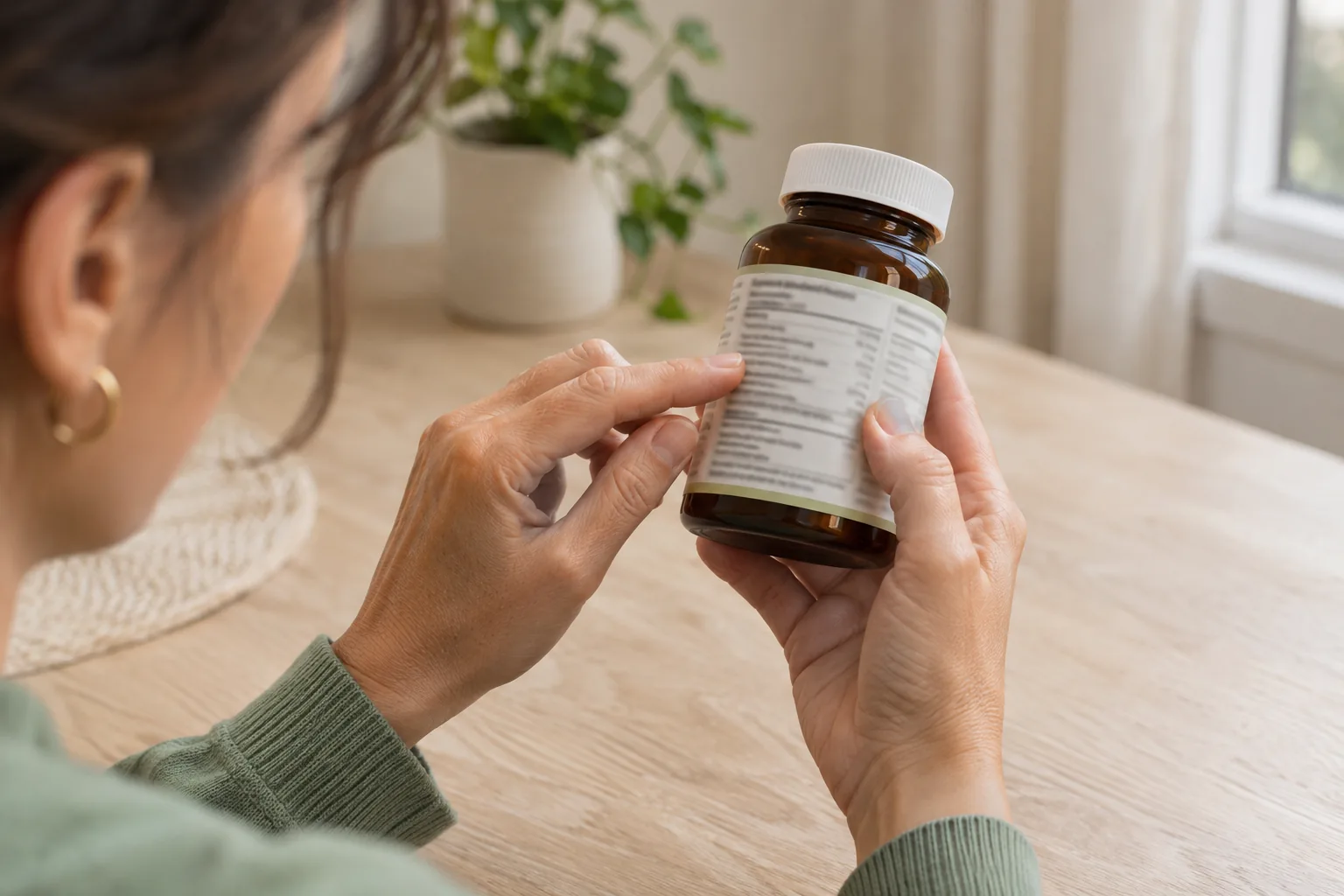
The Supplement Facts panel lists serving information and ingredients; check the actual amounts and the other-ingredients list as well. Keep the full current label available when asking a pharmacist or clinician about a product. A short selection of ingredients on a landing page is not the complete label. [1]
| Check | Write down |
|---|---|
| Exact product and version | Name, format and the date you checked the label. |
| Serving information | Serving size and number of servings in the container. |
| Ingredient details | Amounts, named extracts and anything not disclosed clearly. |
| Other ingredients and warnings | The complete list and any questions relevant to your circumstances. |
Ask which evidence applies to this formula
There is an important difference between a promising explanation and a demonstrated result. When a seller cites a study, look for the product or ingredient studied, the amount used, the participants, the comparison and what was actually measured. A link to research is the beginning of that check, not the conclusion.
An editorial example: a study of ingredient A at one amount does not answer every question about a blend containing A, B and C. Write “not established by this source” when the cited information does not answer your question. Do not turn a gap into a positive or negative certainty.
NCCIH recommends checking reliable information and discussing supplement use with a healthcare professional. Testimonials and natural-sounding descriptions do not settle whether the expected benefit is supported or whether a product is appropriate for you. [2]
Separate manufacturing information from effectiveness
Manufacturing practices and independent quality testing can address questions about what a product contains and how it is made. NIH explains that a quality-assurance seal does not guarantee safety or effectiveness. If a seller displays a seal, check what it covers and whether it applies to that exact product. [1]
Record distinct answers: “manufacturing information supplied”, “complete label available” and “benefit evidence applicable to this formula”. Keeping separate boxes is more informative than a single trust badge. An unanswered box is a reason to ask a question before deciding.
Bring your own context to the decision
The FDA does not approve dietary supplements for safety and effectiveness before sale. Availability on a website therefore does not establish that a product is suitable for a particular person. Discuss medicines, other supplements and relevant health circumstances with a qualified professional. [3]
A practical question is: “Here is the current label and everything I take. What should I clarify before considering this?” Bring the package information, not just a brand name. This guide does not recommend changing a prescribed medicine, combining products or choosing a dose.
Compare the complete purchase, not just a headline price
For a shopping comparison, use the same basis for each offer. Record the quantity, currency, shipping, taxes shown at checkout, items included and whether the purchase is one-time or recurring. An offer with more containers can require more money today even when its displayed per-unit price is lower.
Illustrative arithmetic, not a live offer: a $45 item with $8 shipping costs $53 before any applicable tax. Three items for $120 cost $40 each only if there are no additional charges. This calculation compares spending; it does not predict health benefits or decide how much you should use.
For US and Canadian orders, verify the destination and currency on the seller’s final checkout. Do not assume that a shipping promotion for one region applies to another. Keep the final order summary so you can later check exactly what you agreed to purchase.
Read the return process before ordering
A guarantee headline is only a starting point. Find when the clock starts, whether returns must arrive or merely be sent by the deadline, what can be opened, which costs are excluded and whether prior authorisation is required. Save the terms that apply to the order you actually place.
If two seller pages give different information, ask the seller to confirm the applicable conditions before paying. A publisher cannot make the seller’s promises on its behalf. In our product guides, we link to the seller rather than representing a refund as something we can issue.
Use a decision sheet you can reuse
- Purpose: I can describe what I want to learn or compare.
- Label: I have the complete, current product information.
- Evidence: I know what is supported, uncertain or not assessed.
- Suitability: I have identified questions for a qualified professional.
- Cost: I know the complete total and any recurring terms.
- Purchase: I understand the seller, delivery and return process.
Use “known”, “unclear” and “ask before deciding” rather than a total score. The purpose is to preserve the questions that matter, not create a medical recommendation from a checklist. You can keep a copy on paper without sharing personal information with this site.
Sources & further reading
- NIH ODS — Dietary supplements: what you need to know
- NCCIH — Using dietary supplements wisely
- FDA — Questions and answers on dietary supplements
Sources checked October 31, 2026. Practical tables and examples are editorial tools. They have not been clinically validated. No named medical review is claimed.